
Aug 13, 2026UAV Tether Buying Guides
Fiber Optic Spool: What Makes a Good UAV Spool?
Learn how a fiber optic spool works in UAV systems and what matters when choosing one for long-range communication, mapping, inspection, and rescue.
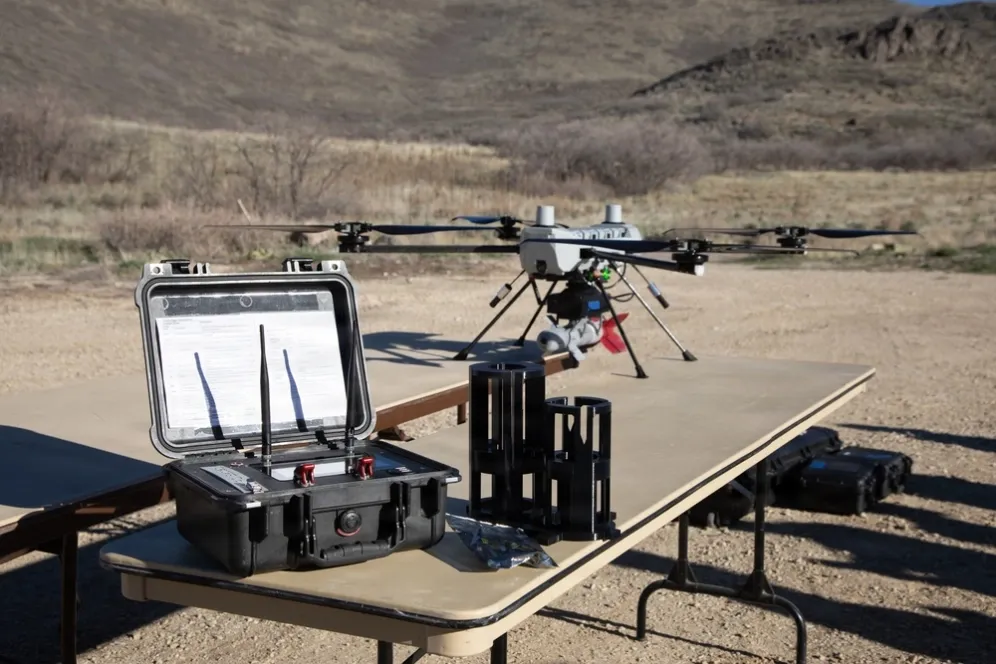
Fiber Optic Spool: The Small Component That Can Make a Big Difference
There is a funny thing about drone technology.
When people look at a new UAV, they normally notice the aircraft first. The motors, camera, battery, flight controller and payload all get plenty of attention. The communication system usually comes later.
But once a drone starts going farther, communication becomes harder to ignore.
A drone can still have plenty of battery left. The camera can still be working. The motors are fine. And yet the operator may suddenly have a problem because the wireless link is becoming unreliable.
This is one reason fiber optic spool systems have become more interesting for professional UAV applications.
The idea itself is not complicated. A length of optical fiber is wound onto a spool and deployed as the drone moves away from the operator or ground station. Instead of depending entirely on a radio link, data can travel through the physical fiber connection.
It sounds simple.
The engineering behind it isn't quite so simple.
What Exactly Is a Fiber Optic Spool?
A fiber optic spool is basically a controlled way of storing and deploying optical fiber.
For UAV use, the spool becomes part of a larger communication system. Depending on the design, the system can include the drone, optical transceivers, ground equipment and the fiber itself.
As the UAV moves, the fiber is released from the spool. The connection remains between the aircraft and the ground side while the drone continues its mission.
That physical connection is the important part.
With a conventional radio-controlled drone, the communication path is wireless. With a fiber-connected UAV, the communication path is carried through the fiber.
Research into fiber-tethered UAV systems has also looked at using the physical tether for high-capacity communication and other functions. Recent academic work continues to explore fiber-tethered UAVs for aerial optical networking and communications.
So, no, a fiber optic spool is not just a reel with some cable inside it. The spool has to work with the aircraft, the cable and the communication equipment as one system.
Why Would a Drone Need a Fiber Optic Spool?
For a normal recreational drone, it probably doesn't.
If you are flying around a park to take a few videos, a wireless connection is much easier. There is no cable to manage, and the drone has much more freedom to move.
Professional UAV missions can be different.
Think about a drone being used to inspect a remote industrial site. Or a UAV collecting mapping data over a large area. Or a drone being used by a response team after a disaster.
In these situations, the operator may care less about having completely unrestricted movement and more about keeping the communication link dependable.
The FAA itself highlights the importance of the communications link as part of a UAS preflight inspection. It also recognizes UAV use in areas such as public safety, disaster response, search and rescue and infrastructure-related operations.
That tells us something fairly obvious: communication is not a side issue in a professional drone system.
It is part of the operation.
The Real Advantage Is Not Simply "Longer Range"
You will often see fiber optic drone systems described as long-range communication solutions.
That is true, but it doesn't tell the whole story.
The bigger attraction is consistency.
Radio communication can be affected by the environment. Buildings, terrain, other transmitters and electromagnetic activity can all change the conditions around a UAV.
Optical fiber works differently.
The information travels through the fiber as light rather than being sent through the air as an RF signal. This gives fiber communication strong resistance to electromagnetic and radio-frequency interference.
A patent describing airborne fiber-optic links for UAVs specifically identifies immunity to EMI and RFI as an advantage of using fiber as the communication path.
This is particularly useful when a drone has to operate somewhere that is simply not friendly to wireless communication.
And that's the point many people miss.
A fiber optic spool is not necessarily about making a drone fly the furthest possible distance. Sometimes it is about making sure the connection behaves the way you expect it to.
The Spool Itself Matters More Than It Looks
Here is where the subject gets a little more interesting.
People often pay attention to the fiber specifications and forget about the spool.
That can be a mistake.
Imagine putting several kilometers of fiber onto a UAV. The cable has weight. It takes up space. It has a minimum bend radius. It needs to come off the spool without creating excessive tension.
If the reel is poorly designed, the fiber can become the problem rather than the solution.
A good UAV fiber optic spool therefore has to deal with several practical issues.
Weight
Drone payload is limited.
Adding a reel, cable and communication hardware means adding weight to the aircraft. The longer the fiber, the more important this becomes.
For a 1KM system, the weight problem may be manageable.
For a much longer system, it becomes a serious design consideration.
Cable Deployment
The fiber should come off the spool smoothly.
It should not suddenly pull against the UAV or create unnecessary resistance as the aircraft changes direction.
This sounds like a small mechanical detail. During a real flight, it isn't.
Cable Protection
Optical fiber is designed to transmit data, but it is not something you want to treat like a steel wire.
The cable may experience vibration, pulling forces and contact with the environment. The reel needs to protect the fiber during storage and deployment.
Packaging
There is also the simple question of where everything goes.
A UAV has limited room.
The spool needs to fit the aircraft without interfering with the propellers, payload, sensors or other equipment.
Good engineering is often about making several things fit together without creating a new problem somewhere else.
What Happens When the Fiber Gets Longer?
Longer isn't automatically better.
This is worth saying because "60KM" looks impressive on a product page, but the actual application matters more than the number.
A longer fiber means more cable weight and a larger spool. The aircraft also has to carry that system while maintaining acceptable flight performance.
The mission profile matters too.
A mapping UAV may have very different requirements from an FPV platform. A surveillance aircraft may be designed around endurance, while another platform may care more about speed or maneuverability.
So when someone asks, "Can I put a 60KM fiber optic spool on my drone?" the better question is:
What drone, what payload, what flight profile and what communication system are you using?
There isn't one answer for every aircraft.
Where Fiber Optic Spools Make Sense
One of the more interesting areas is long-range surveillance.
A UAV can provide an elevated view of a large area while the operator remains on the ground. If the mission requires stable data transmission over an extended distance, a fiber connection can be attractive.
The same basic idea can be useful in inspection work.
Imagine an operator inspecting infrastructure where wireless communication is unreliable. The drone may not need unlimited freedom of movement. It needs a dependable connection while it does the job.
Emergency response is another possible application.
The FAA has specific resources for public safety drone programs and notes the use of UAS in emergency situations.
During a disaster, communication conditions can be unpredictable. A UAV equipped with a fiber-based communication system can provide another option for maintaining the connection between the aircraft and its operators.
Mapping is a little different.
The drone may be carrying high-resolution cameras or other sensors and collecting a lot of information. In that case, communication stability becomes part of the data collection workflow.
The operator needs to know what the drone is seeing and whether the mission is progressing properly.
Fiber Optic Spool vs Wireless: It Is a Trade-Off
It would be wrong to say that fiber optic communication is simply "better" than wireless communication.
It isn't.
Wireless drones have a huge advantage: freedom.
There is no physical cable behind the aircraft. The drone can change direction quickly and operate without worrying about cable deployment.
A fiber-connected UAV gives up some of that freedom in exchange for a more controlled communication path.
So the decision really depends on the mission.
Requirement | Wireless UAV | Fiber Optic UAV |
|---|---|---|
Free movement | Excellent | More limited |
Deployment | Simple | Requires spool and cable |
RF interference resistance | Depends on environment | Very high |
Long-distance communication | Environment dependent | Suitable for dedicated long-range systems |
Cable management | Not required | Important |
Real-time data stability | Depends on link | Strong potential |
System complexity | Generally lower | Higher |
Neither system wins every situation.
The interesting part is knowing when a fiber optic spool solves a problem that wireless communication cannot solve easily.
What Should You Ask a Fiber Optic Spool Manufacturer?
Before choosing a system, I would not start with the question "How many kilometers?"
There are a few other questions worth asking first.
How much does the complete system weigh?
Not just the fiber. Ask about the reel, connectors, optical modules and everything that will actually go onto the UAV.
How is the cable deployed?
A long cable that doesn't deploy smoothly is not much use.
What type of fiber is being used?
Fiber characteristics, mechanical protection and bending requirements all matter.
What UAV is the system designed for?
A reel for one aircraft may not be suitable for another.
What is the intended mission?
Surveillance, mapping, FPV, inspection and emergency response all have different priorities.
And perhaps most importantly:
Has the system been tested as a complete UAV setup?
A fiber optic cable can look excellent on paper. A reel can also look excellent on paper. What matters is how the complete system behaves when the drone is actually flying.
TECHMAX Fiber Optic Spool Solutions
TECHMAX GLOBAL SDN. BHD. is a Malaysia-based company focused on UAV fiber optic spool solutions.
Our approach is fairly straightforward: the reel, cable and UAV communication system need to work together rather than being treated as separate products.
TECHMAX fiber optic spool solutions are developed for applications requiring long-distance and stable communication, with configurations covering 1KM to 60KM.
Depending on the application, the systems can be used for:
- Long-range patrol and surveillance
- Search and rescue
- Aerial mapping
- Industrial inspection
- FPV and special-mission UAV platforms
For long-range applications, we also pay attention to the less obvious parts of the system — weight, cable strength, deployment and compatibility.
Because in the real world, those details tend to matter.
A product can have a great specification sheet. But if the reel adds too much weight or the cable does not deploy properly, the specification does not help much.
Where Is Fiber Optic Spool Technology Heading?
Fiber-connected UAVs have received much more attention recently, both in research and in practical drone development.
A 2026 paper in Drones examined fiber-tethered UAVs for aerial optical access networks, showing that fiber-connected UAVs are being studied as part of broader communication infrastructure rather than only as a niche drone technology.
At the same time, universities are building experimental fiber-connected UAV platforms to test real-time video, telemetry and command-and-control over optical links.
That does not mean every drone will become fiber-connected.
Wireless communication is not going away.
But for certain missions, especially those where communication reliability is more important than unrestricted movement, fiber optic spools are likely to remain an important part of the UAV toolbox.
Final Thoughts
A fiber optic spool is a fairly small part of a UAV system.
It does not have the visual appeal of a new camera or a powerful motor.
But when a drone is operating several kilometers from its operator, the communication system suddenly becomes much more important.
That is really the reason to look at fiber optic spool technology.
Not simply because it offers a long cable.
Not simply because optical fiber has high bandwidth.
It is because a physical communication link can provide a different level of predictability in environments where wireless communication may be difficult.
For some UAV missions, that trade-off is worth it.
And for companies developing long-range drones, the spool is one of those components that is better to get right before the aircraft leaves the ground.
Reliable Information Sources
Federal Aviation Administration (FAA) — Small UAS Regulations and Communications Link Requirements
The FAA's current Part 107 guidance includes checking the communications link between the control station and drone as part of preflight responsibilities.
FAA – Small Unmanned Aircraft Systems (UAS) Regulations
Federal Aviation Administration — Public Safety Drone Programs
Useful reference for the use of UAS by public safety agencies and emergency response organizations.
FAA – Operate a Drone, Start a Drone Program
MDPI Drones — Fiber-Tethered UAV Research
A 2026 peer-reviewed research article examining fiber-tethered UAVs and optical communication networks.
Fiber-Tethered UAV-Enabled Adaptive Aerial Optical Access Networks
Google Patents — Expendable Airborne Fiber Optic Link
Technical reference describing fiber-optic links between UAVs and ground stations, including their communication and interference-resistance characteristics.
Expendable Airborne Fiber Optic Link