
Jul 23, 2026Technical Guides
UAV Fiber Optic Tether: Engineering Specifications for Persistent Aerial Data Links
Explore UAV fiber optic tether engineering specs: bandwidth, tensile strength, attenuation. Learn how to specify and source tethers for industrial drone applications.
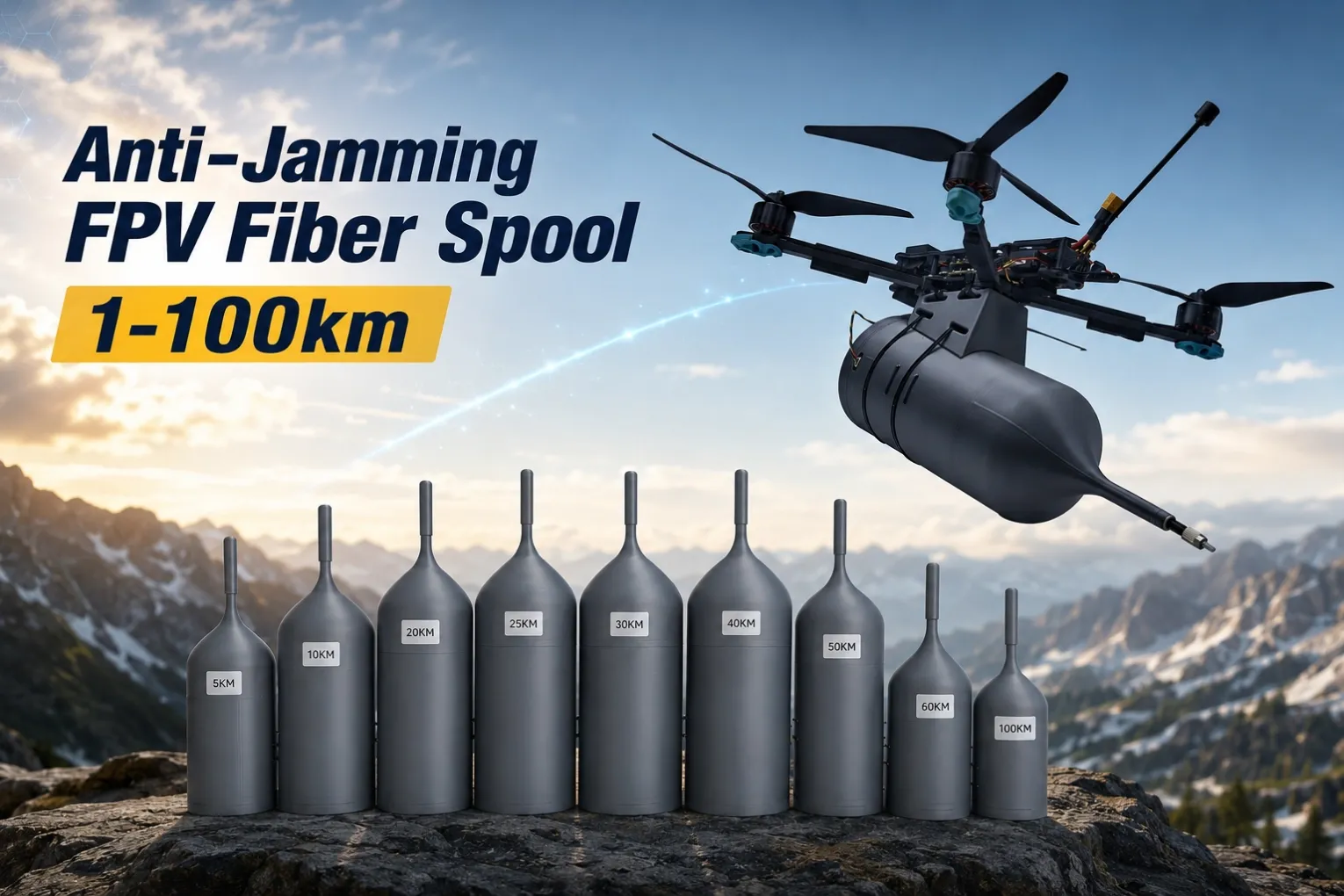
A UAV fiber optic tether is a lightweight, high-bandwidth data link for tethered unmanned aerial vehicles. Fiber optic strands carry signals through light pulses, so they resist radio frequency interference. This matters in busy airspace near power lines or city centers. Reliable signal transmission directly affects mission success for operators using persistent aerial platforms.
Industrial operators increasingly choose fiber optic tethers for surveillance, inspection, and communication relay work. The technology keeps signal quality steady over long distances. This supports border monitoring, pipeline inspection, and similar tasks where precise sensor data drives decisions. Tethered drone systems depend on these reliable connections to maintain continuous operation without the risk of wireless dropout.
What Is a UAV Fiber Optic Tether and Why It Replaces Coaxial Cable
A UAV fiber optic tether is a composite cable with optical fibers inside a protective jacket. It delivers continuous power and high-speed data between a ground station and an airborne drone. Coaxial cable uses copper conductors, which weaken signals over distance and pick up electromagnetic interference (EMI). This becomes a real problem when drones fly near radio transmitters, substations, or city wireless networks.
Fiber avoids EMI issues entirely. Light pulses through glass carry the signal, so no metal path exists to attract stray fields. The tradeoff is higher upfront cost and more complex termination—fiber connectors need careful polishing and testing equipment. Pick fiber when your mission requires sustained data rates above 1 Gbps, extends beyond 500 meters from the ground station, or operates in congested RF environments where signal integrity determines success.
For persistent aerial platforms requiring extended flight durations, fiber optic tethers also provide a stable mechanical link that allows continuous power delivery. This eliminates the weight penalty and safety concerns of large onboard battery banks while enabling unlimited endurance when connected to ground-based power sources. Industrial tethered systems leverage this advantage for round-the-clock security monitoring and infrastructure surveillance operations.
Critical Electrical Specifications: Bandwidth, Attenuation, and Shielding Integrity
Attenuation measures signal loss over distance. UAV tether fiber typically shows 0.2–0.5 dB/km at 850 nm. Lower attenuation means more signal reaches the ground station, preserving link budget. Calculate total system loss before purchasing cable—if you fall below receiver sensitivity, you need expensive repeaters or reduced range.
Bandwidth separates multi-mode (MM) from single-mode (SM) fiber. MM fiber handles up to 10 Gbps—fine for real-time video and standard sensors on short tethers. SM fiber carries 100 Gbps, needed for hyperspectral imaging or multi-channel data fusion beyond 500 meters.
Termination quality affects shielding integrity. Precision CNC-polished LC or SC connectors achieve insertion loss below 0.3 dB per IEC 61300-3-34, verified through 100% OTDR testing. Poor terminations create reflectance events that disrupt clock recovery in digital links—choose assemblies with test reports over field terminations.
For advanced persistent aerial surveillance missions, the choice between MM and SM fiber becomes critical when integrating multiple sensor payloads. Multi-channel data fusion from thermal imagers, LIDAR systems, and high-resolution cameras demands the bandwidth headroom that single-mode fiber provides. This ensures all sensor streams reach the ground station simultaneously without compression artifacts or latency issues that could compromise real-time decision making.
Tolerances run ±0.5% for cut cables; connectorized assemblies hold tighter at ±0.1 mm ferrule protrusion. Specify your exact span and payload bandwidth when requesting a quote.
Mechanical Requirements for Airborne Deployment: Tensile Strength and Bend Radius
UAV tethers handle continuous tensile loads from platform weight, wind shear, and winch movement. Tensile strength typically spans 200–1500 N, with a 3:1 safety margin above calculated loads. This prevents mid-mission failure that risks asset loss. Cable jacket material sets this range—aramid reinforcement boosts strength but adds mass, directly affecting flight endurance.
Bend radius shapes routing around the airframe and winch drum. Exceeding minimums creates microbending losses that spike attenuation during flight. Specify ≤20 mm for tight gimbal routing. Choose ≥50 mm for large-drum deployments. Verify mechanical ratings against your drone's gross weight before integration.
The winch mechanism in tethered drone systems introduces cyclical loading that accelerates fatigue in lesser cables. Aramid yarn reinforcement between the inner buffer and outer jacket distributes stress concentration points along the cable length. This design extends service life under repeated deployment cycles typical of industrial surveillance operations where systems may cycle 10-20 times daily during peak operational periods.
Environmental Ratings and Failure Limits for Industrial Drone Operations
Industrial drone deployments expose tethers to harsh conditions far beyond lab environments. Operating temperature ranges of -40 to +85 °C handle high-altitude cold and desert heat. However, repeated thermal cycling fatigues primary coatings—expect attenuation creep after 500+ cycles in unheated storage. Choose FEP jackets for chemical exposure near pipeline sites. PUR resists abrasion but degrades when exposed to petroleum solvents.
IP67 sealing protects connector interfaces from rain and temporary submersion. Yet constant vibration in aerospace and logistics applications works O-ring seals loose over time. Failure follows predictable patterns: tensile overload above rated N forces jacket rupture. Exceeding minimum bend radius causes immediate microbending losses. Test pull-out force at 120% of rated load before first deployment.
For maritime operations involving persistent aerial platforms deployed from vessels, salt spray exposure demands enhanced corrosion protection beyond standard IP67 ratings. Stainless steel connector housings and hydrophobic seal compounds become necessary upgrades. Coastal surveillance missions should specify marine-grade components that resist galvanic corrosion at electrical junctions.
Specifying and Verifying a UAV Fiber Optic Tether on Datasheet or RFQ
Cross-reference datasheet attenuation figures against your calculated link budget. Discrepancies expose integration risk before build confirmation. Request OTDR trace files from suppliers—raw waveforms show connector defects that pass/fail testers miss. Insist on insertion loss testing per IEC 61300-3-34 with documented ≤0.3 dB results. Compare vendor tensile ratings against your drone's maximum gross weight and worst-case wind load to catch undersized components. Ask for 120% proof test documentation before purchase. This confirms structural margin at the factory, not just on paper.
When evaluating industrial drone tether options for critical infrastructure protection, documentation chain matters. Request lot traceability back to raw fiber batch numbers. This enables failure analysis if field issues emerge and confirms consistency across production runs. Suppliers who provide this transparency typically maintain tighter process controls throughout manufacturing.
Technical Specifications
Parameter | Typical Range | Unit | Significance for UAV Application |
|---|---|---|---|
Attenuation | 0.2 – 0.5 | dB/km at 850 nm | Determines maximum tether length before signal regeneration needed |
Tensile Strength | 200 – 1500 | N | Must exceed drone weight plus wind load with safety margin |
Bend Radius (Dynamic) | 20 – 50 | mm | Affects routing around drone body and winch drum geometry |
Operating Temperature | -40 to +85 | °C | Covers extreme ground conditions and high-altitude cold |
Fiber Type | Single-mode (SM) or Multi-mode (MM) | — | SM for >1 km links; MM for shorter high-bandwidth payloads |
Cable Diameter | 2.0 – 6.0 | mm | Impacts weight budget and drone gimbal clearance |
Bandwidth Capacity | Up to 10 Gbps (MM) / 100 Gbps (SM) | — | Drives real-time video, sensor data, and control channel throughput |
Jacket Material | PUR or FEP | — | PUR offers flexibility; FEP resists chemical exposure on job sites |
Frequently Asked Questions
What is the maximum transmission distance for a UAV fiber optic tether?
The effective transmission distance depends on fiber type and budget allocation. Multi-mode fiber supports distances up to 500 meters with minimal loss. Single-mode fiber extends beyond 10 km in ground-station configurations, though typical UAV tether deployments range from 50 to 500 meters. For operations requiring links beyond 500 meters, single-mode fiber with low-attenuation grades (below 0.22 dB/km) maintains signal integrity without repeaters.
How does fiber optic tether compare to wireless links for drone operations?
Fiber optic tethers provide deterministic latency and immunity to RF interference that wireless links cannot match. Wireless systems suffer from spectrum congestion, line-of-sight requirements, and potential interception risks. Fiber delivers guaranteed bandwidth with consistent round-trip delay, which is critical for real-time sensor fusion and autonomous flight controls. The trade-off involves the mechanical complexity of managing the physical tether during flight operations.
Can fiber optic tethers carry power alongside data signals?
Standard fiber optic tethers transmit data only—light pulses through glass fibers carry no electrical current. Power delivery requires hybrid cable construction that combines optical fibers with copper power conductors. These hybrid tethers add weight and cost but enable unlimited flight endurance by powering the drone from the ground station. Specify hybrid construction when your persistent aerial platform requires continuous operation beyond standard battery flight times.
What maintenance is required for UAV fiber optic tethers?
Factory-terminated assemblies require minimal maintenance beyond visual inspection before each deployment. Check connector end-faces for contamination or scratches using a fiberscope. Verify jacket integrity for cuts or abrasion damage after rough handling. Re-test insertion loss annually or after any incident involving connector impact. Field termination is not recommended—return assemblies to the manufacturer for proper polishing and testing when connector replacement becomes necessary.
What is the typical lifespan of a UAV fiber optic tether?
Service life depends heavily on deployment environment and handling frequency. Well-maintained tethers operating in benign conditions typically last 3-5 years. Abrasive environments with UV exposure, thermal cycling, or chemical contact can reduce functional lifespan to 12-18 months. The winch cycling frequency significantly impacts longevity—systems deployed for continuous monitoring experience faster fatigue than those used intermittently for inspection missions.
Ordering, MOQ & Lead-Time Notes
Typical MOQ for custom-length UAV fiber optic tethers starts at 100 meters for standard builds. Volume pricing becomes available for orders exceeding 500 meters through our project team. Standard production lead time for bespoke UAV fiber optic tethers ranges from 20 to 30 business days after deposit. Expedited options exist for qualified defense and critical infrastructure projects. Cable construction uses high-grade silica glass fibers with primary and secondary acrylate coatings. Jackets come in either polyurethane (PUR) for repeated flexing or fluorinated ethylene propylene (FEP) for chemical resistance.
Standard length tolerance is ±0.5% for cut-to-length cables. Critical dimension tolerances for connectorized assemblies hold at ±0.1 mm on ferrule protrusion. Termination uses precision CNC-polished LC or SC connectors with insertion loss verified to <0.3 dB per IEC 61300-3-34. This is followed by 100% OTDR (optical time-domain reflectometry) continuity testing. Small orders often lack economic viability for wholesalers due to low profit margins per item and high processing time relative to revenue.
If you are specifying UAV fiber optic tether for a live project, Get pricing for your specification with your duty point, medium, and site constraints. Or send your RFQ and our engineers will return a matched recommendation with pricing.
Last Reviewed: July 2026